

REVIEW · TICKETS
Beijing:Drum and Bell Towers Entry Ticket- Cultural Treasure
Two towers, one ancient clock. Beijing’s Drum Tower and Bell Tower are where the city once kept time, and the buildings still feel like they mean business. You get both towers in a tight visit, with e-tickets and an English guide to help you read what you are seeing.
I especially like the way the complex connects big Chinese history to a very physical experience. These towers were built as a time-telling center starting in the Yuan Dynasty, and they continued through the Ming and Qing eras, using a simple idea, a dusk drum and a morning bell. Second, the included English textual and visual guide (often shared as a PDF) is more than filler, it can point you toward nearby hutongs and even help you pick local restaurants after you finish the towers.
The main drawback is the climb. Reviews flag that the stairs are steep and fairly long, so if mobility is an issue, you will want to think hard before committing.
In This Review
- Key takeaways before you go
- Why Beijing’s Drum and Bell Towers still feel practical
- Where the towers sit, and why the “north end of the axis” matters
- Entering with e-tickets: the fastest way to start your visit
- Bell Tower: the Ming-era bell story and what to watch for
- Drum Tower: the dusk drum detail and why the “25 drums” matters
- Using the included English guide to get more from less time
- A realistic 2-hour plan that won’t leave you rushing
- Price check: is $13 per person good value
- Who this visit is best for
- Should you book this Drum and Bell Towers ticket?
- FAQ
- What do I need to bring for entry?
- How do I receive my tickets?
- How far in advance are tickets reserved?
- How do I enter the Bell Tower and Drum Tower?
- What is included with the ticket?
- How long should I plan to spend there?
Key takeaways before you go
- Yuan to Qing timekeeping: the complex served as Beijing’s clock system for centuries
- The Yongle bell detail: the “King of Ancient Bells” legend ties to a bell said to weigh 63 tons
- Skip-the-line entry: e-tickets let you enter directly without a separate ticket counter stop
- English help you can use fast: a textual and visual guide plus a PDF style brochure that may include hutong and food tips
- Plan for stairs: expect steep, long stair sections in both towers
- Bell Tower sits slightly north: the layout helps you orient the walk between the two
Other Beijing trips our reviewers kept returning to
- Beijing: Forbidden City Tour(Group/Private)-Tickets Included★ 4.8 · 7,974 reviews
- 4-Hour Small Group Tour to Forbidden City with Entry Tickets★ 5.0 · 1,863 reviews
- Beijing: Tiananmen Square Registration Service(Ticket)★ 4.5 · 1,704 reviews
- Beijing: The Temple of Heaven or Summer Palace Entry Ticket★ 4.6 · 1,286 reviews
Why Beijing’s Drum and Bell Towers still feel practical

If you like places where the past has a job to do, you’ll get it fast here. The Drum Tower and Bell Tower were built to run the daily rhythm of a city, not just to look impressive.
You can read the story in the architecture and the layout. Both sit at the northern end of Beijing’s central axis, and together they formed a system that ran through the Yuan (1206 to 1368), Ming (1368 to 1644), and Qing (1644 to 1911) dynasties. That long timeline helps you understand why these towers are taken seriously as cultural infrastructure.
This complex is also not tiny. It covers 12,597 square meters and is protected as a historic site at the state level. That scale matters because you will spend your time moving through platforms, stairs, and viewing areas, not just snapping photos at a single doorway.
Where the towers sit, and why the “north end of the axis” matters

I like using location as a shortcut for orientation, and this site gives you one. The towers are positioned at the northern end of Beijing’s central axis, which is a big clue to how the city was planned and viewed.
There’s also a simple spatial detail that helps your visit feel logical. The Bell Tower is slightly north of the Drum Tower, so your route between them naturally feels like walking along a planned line rather than bouncing around randomly.
That pairing makes it easier to do a self-guided visit without feeling lost. Even if you are not memorizing old city planning diagrams, you can use the axis idea to keep your bearings while you move between towers.
Entering with e-tickets: the fastest way to start your visit
This ticket package is built for an easier arrival. After you place your order, you provide your passport name, passport number, and date of birth. Tickets are reserved 3 days prior to your visit, then you receive e-tickets by email or WhatsApp once the reservation works.
Once your e-tickets arrive, you can enter the Bell Tower and Drum Tower directly with the QR codes included. That is the key value point here: you spend your energy looking up, reading, and walking the stairs, not standing around at a counter.
A small but important note, bring the right ID. The activity specifies you should have your passport or ID card with you, which matters if a checkpoint asks for it.
Bell Tower: the Ming-era bell story and what to watch for

The Bell Tower is the one many people remember first because of the dramatic legend tied to the bell. Time was told by a morning bell, and the idea here is that sound carried meaning through the day.
This bell is connected to the Ming Dynasty, specifically the Yongle era (1403 to 1424). The text also highlights the weight, said to be 63 tons, and the famous nickname, the King of Ancient Bells of China. Even if you treat the number as legendary emphasis rather than something you can verify on the spot, it still tells you how serious the makers were about scale and authority.
When you are inside, don’t rush. Use your English guide to track what the tower is showing you in plain terms. This is a self-guided setup, and that guide is designed to help you make sense of the space without needing a live interpreter.
Also, remember the layout logic while you look around. Since the Bell Tower is slightly north of the Drum Tower, your path through the complex tends to feel like moving along a directional flow, which helps you avoid that classic trap of doubling back too many times.


Drum Tower: the dusk drum detail and why the “25 drums” matters
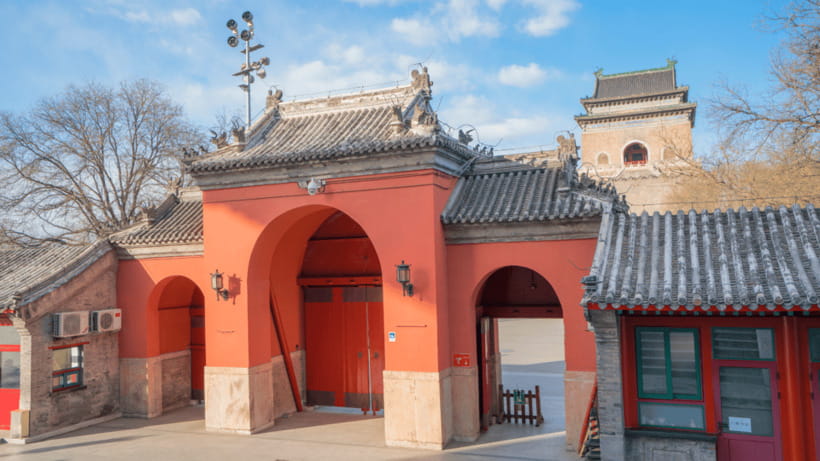
The Drum Tower carries the other half of the timekeeping phrase, the dusk drum. That matters because it turns the site from a museum stop into a picture of daily routine.
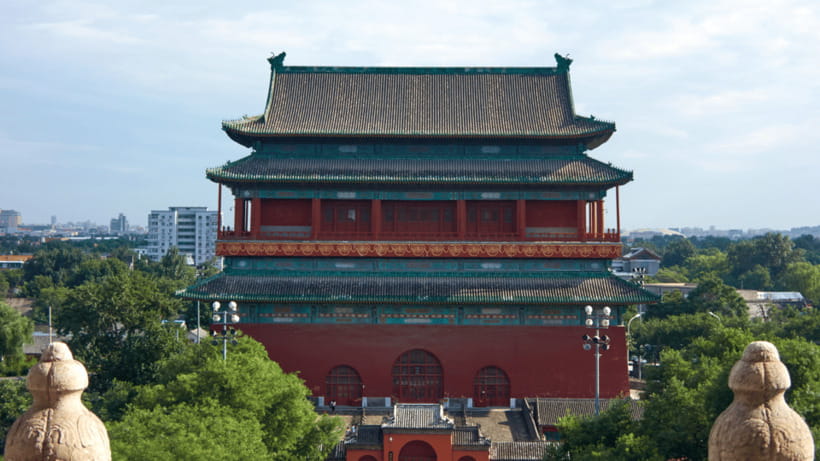
The information here says that there used to be 25 drums in the Drum Tower. That detail is easy to gloss over if you only care about photos, but it is actually a useful clue for understanding the tower’s purpose. A setup with multiple drums implies a system, not a single ceremonial strike.
This complex was the model for a similar type of time-telling structure across ancient China, and it topped others as the time-telling pair in the capital city. Whether you read that as literal ranking or as a way of saying it represented the best standard, the takeaway for your visit is the same: you are standing in a place meant to be a reference point.
Again, pace your time. Expect to climb. The one clear downside flagged in reviews is that the stairs are steep and fairly long, and you’ll feel that in your legs here. If you know you tire easily, plan your energy so you can still enjoy the views and the guide material instead of just surviving the climb.
Using the included English guide to get more from less time

You are paying for more than entry. This ticket includes an English textual and visual guide for both towers. There is no live tour guide and no audio guide included, so the guide you receive is your main “human” help.
If you like to learn while you walk, this format can be perfect. You can check a section as you reach a relevant area, then move on. That keeps your visit from turning into a blur of random facts.
One standout detail from the experience is how useful the guide can be beyond the towers themselves. In at least one case, the PDF brochure included information about nearby hutongs and even recommendations for local restaurants. That matters because Beijing visits often fail when people treat the towers like an isolated postcard.
If you want the towers to be the start of a bigger day, look at your guide before you go, or as soon as you enter the site area. Then plan to add a short hutong wander and a meal nearby after your tower time is done.
A realistic 2-hour plan that won’t leave you rushing
The duration is listed as 2 hours, so I’d plan your mindset around that time box. This is not a half-day deep research mission, it is a focused visit where you get the main experience and then move on.
Here’s how I’d structure it so you are not stuck running. First, start with one tower, take your time climbing and reading, then do the second tower while your brain is still in “timekeeping mode.” Since the Bell Tower sits slightly north of the Drum Tower, a natural flow is to follow the axis from Bell toward Drum, but follow what feels easiest with your approach.
While you are inside, use the guide in short bursts. When you hit a point that matches what the text is explaining, pause and look longer. When you do not, keep moving. That way your 2 hours feel full without becoming exhausting.
Also, factor in stair time. Reviews explicitly warn about steep and fairly long stairs, so give yourself a buffer. If you arrive ready to pace yourself, you will have a calmer visit and still enjoy the details.
Price check: is $13 per person good value

At $13 per person, this ticket is aiming for “easy and organized” rather than “lowest price ticket.” You are paying for bundled entry to both towers plus the English guide and the e-ticket convenience.
Is it great value? It can be. The big value lever is the skip-the-ticket-line approach via e-tickets, because queues are where a good plan turns into a long day. Another lever is the guide, especially if you take the hutong and food suggestions seriously and turn the towers into a half-day outing.
That said, there is at least one very direct complaint in the provided feedback about the price feeling excessive compared to what someone might pay on site. I get that reaction, because it is hard to ignore the feeling of overpaying when you think you could have bought the same thing elsewhere for less.
So here’s the fair way to decide. If you hate waiting and you want English support with almost no effort, this can feel worth it. If you are purely chasing the lowest ticket cost and you are comfortable with uncertainty at the gate, you might judge the price differently.
Who this visit is best for
This is a strong match if you want a clear, self-guided cultural stop. You get two major Beijing landmarks, a textual and visual guide, and an entry method that is designed to be smooth.
It is also a good choice if you like practical planning. The process asks for passport details and sends your e-tickets ahead of time, which can be useful when you are trying to manage busy days. In at least one case, the service was used during Golden Week, when demand is high, and the advantage of advanced tickets was clearly part of the appeal.
Where you should be careful is mobility. Because the towers involve steep, long stair sections, this may not suit everyone. If climbing is hard for you or someone in your group, it is worth assessing that before booking.
Should you book this Drum and Bell Towers ticket?

Book it if you want a calm, organized way to visit both towers with English support and e-ticket entry. I like that the guide is included and that it can connect your tower time to nearby hutongs and food ideas, so your visit does not feel like you stopped only to check a box.
Pass or reconsider if stairs are a dealbreaker for you, or if you are extremely price-sensitive and would rather gamble on buying at the gate. Also, remember that the reservation needs passport or ID details and you should keep your ID with you at entry.
If you want the simplest path to a meaningful visit, this one fits: two towers, one focused 2-hour plan, and a guide you can actually use.
FAQ
What do I need to bring for entry?
You should bring your passport or ID card. The reservation process also requires your passport name, passport number, and date of birth.
How do I receive my tickets?
After the reservation is successful, the e-tickets are sent to you via email or WhatsApp. They include the access you need for entry.
How far in advance are tickets reserved?
Your tickets are reserved 3 days prior to your visit date.
How do I enter the Bell Tower and Drum Tower?
You can enter the Bell Tower and Drum Tower directly using the e-tickets you receive, so you do not need to purchase a ticket on site to get in.
What is included with the ticket?
You get tickets for the Bell Tower and Drum Tower, plus an English textual and visual guide for both.
How long should I plan to spend there?
Plan for about 2 hours, and check available starting times to fit your schedule.
More Tickets in Beijing





More Tour Reviews in Beijing




Beijing, reviewed one booking at a time
- Xian: Must see Eternal Love or Camel Bell Legend show Ticket
★ 5.0 · 3 reviews - One day tour to downtown Tianjin from Beijing by high speed train
★ 5.0 · 3 reviews - Ming Tombs Sacred Way & Underground Palace & Water Wall P Tour
★ 5.0 · 3 reviews - Beijing Mutianyu Great Wall Small Group Tour
★ 4.5 · 3 reviews - Return Bus to Badaling Great Wall
★ 3.0 · 3 reviews - Private Tour to Lama Temple, Tian’anmen Square and Forbidden City
★ 5.0 · 3 reviews
Tickets, compared.
 ★ 4.8Beijing: Forbidden City Tour(Group/Private)-Tickets IncludedFrom $47,974 reviews
 ★ 5.0Beijing: Mutianyu Great Wall Daily Tour with Ticket & LunchFrom $183,056 reviews
 ★ 5.04-Hour Small Group Tour to Forbidden City with Entry TicketsFrom $151,863 reviews
 ★ 4.5Beijing: Tiananmen Square Registration Service(Ticket)From $31,704 reviews
 ★ 4.6Beijing: The Temple of Heaven or Summer Palace Entry TicketFrom $71,286 reviews
 ★ 4.9Beijing: Mutianyu Gt Wall Trip, Depart 8-10am Bus w/ TicketsFrom $181,256 reviews
 ★ 5.0Forbidden City&T-Square Small GroupTours w/ ticket(Eng/Esp Guide)From $11995 reviews
 ★ 4.3Beijing: The Forbidden City or Tiananmen Square Entry TicketFrom $4836 reviews