
REVIEW · 2-HOUR EXPERIENCES
2-Hour Chinese Calligraphy with an Artist in Shanghai, China
Chinese calligraphy feels like magic at first. This small-group workshop in Shanghai turns that mystique into a calm, guided lesson you can actually use at home. You start with the art’s background, then practice strokes, and finish with a traditional folding fan decorated with your own character, all while working one-on-one enough to stay confident.
I especially love the small group size (max 8), because Lucie can slow down and correct your brush angle before your ink dries. I also like that you get everything included: tools, materials, instruction, plus tea or coffee, so you show up empty-handed and leave with a real souvenir.
One possible drawback: the studio is in a quieter lane area, so you’ll want to follow the meeting directions carefully and give yourself a few extra minutes to find it.
In This Review
- Key highlights worth your time
- How the 2 hours work, step by step
- Where you meet in Jing’an, and how to not get lost
- Calligraphy 101: why the history lesson actually helps
- Tools and technique: what you learn about brush control
- Quick practical tip
- Warm-up practice: where your confidence gets built
- Your take-home artwork: the folding fan with your character
- If you care about style, ask
- Why this is a great value at $50
- Who this workshop suits best
- What to do before and after your class
- What can trip you up (and how to handle it)
- Should you book this Shanghai calligraphy workshop?
- FAQ
- How long is the Chinese calligraphy workshop?
- What is included in the price?
- Do I need any calligraphy experience?
- What language is the class taught in?
- How many people are in the group?
- What is the take-home item?
Key highlights worth your time
- English instruction with Lucie’s clear explanations, so you are not stuck guessing what you are doing
- All tools and materials included, including ink and paper you will use during practice
- A hands-on take-home fan, finished using traditional techniques rather than just watching
- A short history + scripts overview, so your strokes have meaning, not just decoration
- Max 8 people, which keeps feedback personal and reduces wait time at the brush
Other Shanghai trips our reviewers kept returning to
- Private 2-Hour Walking Tour of Shanghai’s Jewish Ghetto★ 4.0 · 33 reviews
- 2-Hour Private Chinese Ink and Brush Painting Workshop in Shanghai★ 5.0 · 15 reviews
- Private 2-Hour Shanghai Lanes and Alleyways Walking Tour★ 4.5 · 14 reviews
How the 2 hours work, step by step
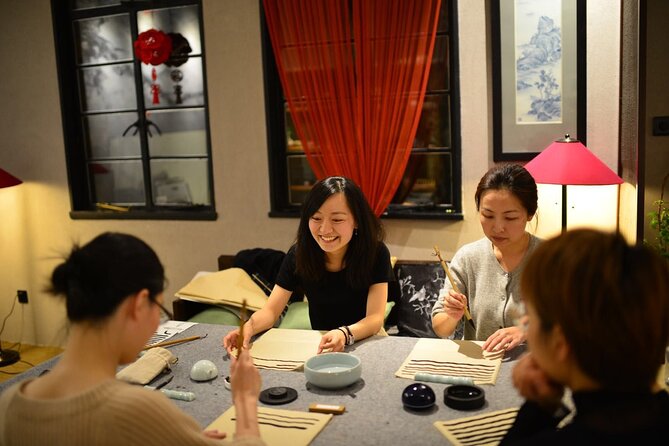
This is a straightforward, friendly 2-hour session, built for beginners and casual learners. There’s no “watch first” approach. You learn the basics, practice a bit, then make a finished piece you can bring home and show off.
You also get options for timing, with morning, afternoon, or evening classes. That matters in Shanghai, where you might want to plan around museum time, day trips, or just dodging crowds.
Where you meet in Jing’an, and how to not get lost
You meet at Yugucun (North Gate), in Jing’an, at Yu Yuan Lu, near Jing’an Temple. The exact address is listed for the North Gate area, and the session ends back at the same meeting point.
This is an in-city neighborhood walk, not a big tourist plaza. One review notes the location can feel a bit off the beaten track, but directions from the nearby metro help. My advice: screenshot the meeting instructions before you go, and check your route in advance. Give yourself a small buffer, because once you are in the lane area, the right building matters.
Calligraphy 101: why the history lesson actually helps
The class starts with a brief overview of Chinese calligraphy history and how people have traditionally viewed this art form. You also hear stories tied to important works and you get context for why certain strokes and styles are respected.
Then comes a practical bridge: Lucie covers basic writing techniques and talks through how the different scripts connect to the look of the final character. Reviews mention that the workshop includes a helpful look at scripts and examples, so even if you do not know a single Chinese character yet, you still understand what you are aiming for.
This part is not filler. It changes how you practice. If you know why a stroke is drawn a certain way, you stop treating calligraphy like “pretty handwriting” and start treating it like controlled movement.
Tools and technique: what you learn about brush control
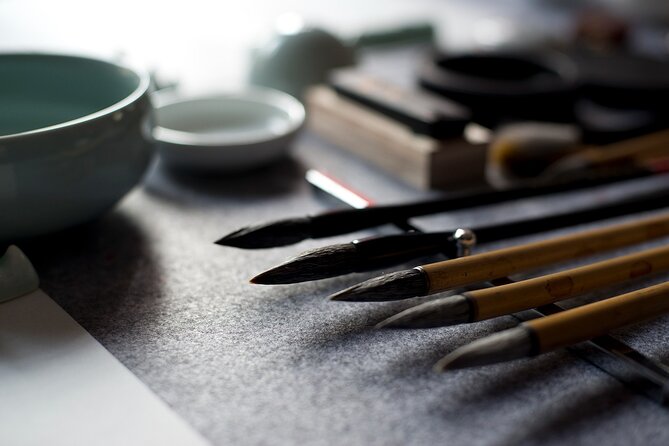
In this workshop, you use classic calligraphy tools. That usually means brush, ink, paper, and the kind of practice you can feel in your hand.
The biggest skill you are building here is control. Brush calligraphy is all about pressure, angle, and timing, and one small mistake turns into a blob. Lucie gives hands-on guidance, so you learn which parts of the stroke matter most and how to correct the problem while you are still mid-practice.
If you have never used a brush like this, you will likely be surprised by two things: ink moves quickly, and making a clean line is harder than copying a photo. Several people mention that the strokes are both easier and harder than expected. That is normal. The workshop is designed to help you get past the first frustration.




Quick practical tip
Ink can stain. Wear sleeves you do not mind, and avoid light-colored clothing if you are cautious. This is not about being messy, it is about being realistic.
Warm-up practice: where your confidence gets built
After the history and tool talk, you do warm-up practice. You build muscle memory for a few fundamental strokes first, then you prepare for the final piece.
This phase is where the class feels most “teacher-led.” Lucie walks you through the characters you selected, helps you refine the hand movements, and checks your form so you do not keep practicing the same mistake for the full 2 hours.
Because the group is capped at 8, you do not get the “line up, watch for a minute, then wait” problem. Feedback stays close, and people often mention how patient and attentive Lucie is during practice.
Your take-home artwork: the folding fan with your character
The final work is a traditional folding fan decorated with calligraphy. That means your character becomes more than a worksheet. It becomes a physical souvenir you can keep and use.
One nice detail is that the workshop pushes you toward a finished piece, not just “some practice strokes.” You warm up, then you work toward the final composition, with guidance as you go. Reviews repeatedly highlight that the finished fan looks like something you can be proud of, even if you start out totally new.
Also, you get to choose your favorite Chinese character. That personalization makes the whole session click. You are not just learning a random example. You are putting meaning into a design you picked.
If you care about style, ask
One review mentions Lucie adapted to a participant who wanted a specific writing script style (regular script instead of seal script). So if you have a preference, it is reasonable to ask during the class. You might not get every option, but the teaching is flexible based on the group’s goals.
Why this is a great value at $50
At $50 per person for about 2 hours, this is priced like an activity, not an “expensive private lesson.” The value is the combination of three things:
- Instruction in English from Lucie
- Tools and materials included, so you are not paying extra for supplies
- A finished take-home piece, the folding fan with your calligraphy
In many cities, even a single guided craft session can cost close to this without including materials. Here, you are paying for coaching plus everything you need to complete the souvenir.
And because the group stays small, you get a better chance of meaningful corrections. That is a big part of why the reviews consistently land at 5 stars.
Who this workshop suits best
This class works for several kinds of travelers.
Best fit:
- First-timers who want more than a photo and want a real skill to practice
- People who appreciate cultural context, not just a handcraft
- Solo travelers who want a calm break from Shanghai’s nonstop schedule
It is also family-friendly, based on reports of kids aged 5, 9, and 12 taking the class and walking away with strong memories. If you travel with children, you can expect supportive teaching, because beginners of different ages can still learn the basic strokes.
What to do before and after your class
Before: pick the character you want in advance, if you can. If you cannot, no worries, you can choose during the session. The key is that your final fan is personalized.
If you want to get more out of the history portion, do a quick scan of Chinese characters you already see around Shanghai. Signs, shop names, and calligraphy on public spaces give you instant context for what you are learning.
After: plan a simple, nearby activity. Since the class ends at the meeting point, you can head toward Jing’an Temple or another nearby stop without a complicated reroute.
And yes, you will likely notice calligraphy more on the streets. That is one of the most common takeaways from people who do calligraphy workshops.
What can trip you up (and how to handle it)
The workshop runs smoothly for most people, but there are a few practical considerations.
- Finding the studio: it is not in a giant tourist corridor. Follow the directions closely and arrive a few minutes early.
- Calligraphy stress: you may feel self-conscious about your first lines. This is normal. Lucie starts with basics, and the warm-up practice exists to reduce pressure.
- Time expectations: you only get 2 hours. You will not become a master in one day, but you will leave with a real souvenir and a clear starting point for practicing later.
Should you book this Shanghai calligraphy workshop?
If you want a short, meaningful Shanghai activity with a take-home piece, I think you should book it. The combination of English instruction, small group teaching, and included materials is a strong value, especially if you are tired of cookie-cutter sightseeing.
You should also book it if you care about understanding what you are doing. The history and scripts overview make your strokes feel purposeful, not random.
Skip it only if you are looking for a hands-off experience, or if you strongly prefer large-scale attractions over quiet skill-building sessions. For everyone else, this is one of those rare trips where you leave with both context and craft in your hands.
FAQ
How long is the Chinese calligraphy workshop?
The workshop is about 2 hours.
What is included in the price?
The price includes all tools and materials, instruction, and tea or coffee. You also make your own finished artwork.
Do I need any calligraphy experience?
No. It is designed for people who can participate as beginners, with step-by-step practice and guidance.
What language is the class taught in?
The workshop is conducted in English.
How many people are in the group?
The class has a maximum of 8 travelers.
What is the take-home item?
You create a traditional folding fan decorated with calligraphy using your chosen Chinese character.
More 2-Hour Experiences in Shanghai



More Tour Reviews in Shanghai





Shanghai, reviewed one booking at a time
- Zhujiajiao Water Town and Shanghai City Highlights Private Day Tour
★ 5.0 · 3 reviews - Zhujiajiao Water Town Private Tour with Local Farm Visit and Fruit Picking
★ 5.0 · 3 reviews - Tongli Water Town Self-Guided Tour with Private Transfer from Shanghai
★ 5.0 · 3 reviews - Shanghai by Night with Fine Local Dinner and VIP River Cruise Experiences
★ 5.0 · 3 reviews - Shanghai Acrobatic Show Tickets
★ 5.0 · 3 reviews - Private Shanghai Layover Tour to Zhaojialou Water Town with Lunch or Dinner
★ 5.0 · 3 reviews
2-Hour Experiences, compared.
 ★ 5.02-Hour “Ancient & Modern” Beijing Sidecar Tour (Day /Night)From $8936 reviews
 ★ 4.0Private 2-Hour Walking Tour of Shanghai’s Jewish GhettoFrom $13133 reviews
 ★ 5.02-Hour Beijing Private Forbidden City Tour: History & HighlightsFrom $8028 reviews
 ★ 5.02-Hour Private Chinese Ink and Brush Painting Workshop in ShanghaiFrom $11815 reviews
 ★ 4.5Private 2-Hour Shanghai Lanes and Alleyways Walking TourFrom $12314 reviews
Browse the lists this tour appears in